







Can free VPNs really offer unlimited data? Yes, but you are often paying with your privacy rather than your wallet. While the internet is flooded with apps promising endless streaming and browsing for zero cost, the reality is often far more complicated.
At TurisVPN, we believe in transparency, so we are peeling back the layers of the “unlimited” marketing promise to show you exactly how these services function, and what you might be sacrificing to get them.
Quick Answer — Can Free VPNs Really Offer Unlimited Data?

Yes, technically, but it almost always comes with a significant trade-off in speed, server availability, or privacy.
- The “Soft” Cap: Many services offer free VPN with unlimited data, but throttle your speed to a crawl after a certain usage threshold.
- The Privacy Cost: If you aren’t paying in money, you might be paying with your personal data (logs, history, IP addresses).
- The Infrastructure Reality: Unlimited bandwidth costs money; free services often lack the server power to support it.
- The TurisVPN Difference: We offer true unlimited data on our free plan by optimizing our server network differently, prioritizing security over throttling.
What “Unlimited Data” Really Means in a Free VPN
Unlimited Data simply means the provider does not set a hard cap on your usage. You can download files or browse the web 24/7 without the service cutting you off. However, users often confuse this with Unlimited Bandwidth, which refers to the connection speed.
Most providers offering a free VPN with unlimited data give you unlimited access, but severely restrict your speed. You stay connected, but the performance is often too slow for modern tasks. Here is the critical difference:
- Data Cap: A strict limit (e.g., 10GB/month). Once you hit this number, the VPN stops working entirely until the next month.
- Bandwidth Throttling: The VPN never disconnects you, but your speed drops to 2G levels after a certain point. This makes streaming or large downloads impossible, even though you technically still have “unlimited data.”
Defining unlimited is one thing, but knowing if these services are actually safe to install is a far more critical issue.
Are free unlimited VPNs safe to use?
Free unlimited VPNs are not considered safe. Maintaining a global server network requires massive capital. If a VPN offers everything for free, it must monetize somewhere else. Often, this results in:
- Intrusive Ads: Pop-ups that disrupt your experience.
- Data Logging: Selling your browsing habits to advertisers.
- Malware: Some dubious “unlimited” Android VPNs contain harmful code.
At TurisVPN, we operate differently. We prioritize user security above all else, allowing us to offer a safe, strict no-logs service without selling your data. This commitment to privacy eliminates the risks that typically make users doubt whether free VPNs are safe for private browsing.
Safety is a major concern, but even if the app is safe, you still have to deal with the hidden performance limits.
The hidden limits behind “free unlimited VPNs”

Free services hide significant restrictions behind the “unlimited” label to manage their server load. These limits are designed to make the free version annoying enough that you eventually pay. Let’s look at the specific ways they restrict you.
Speed throttling after initial usage
This is the most common trick. You might enjoy blazing fast speeds for the first 1GB of data. However, once you pass that invisible threshold, your connection creates a bottleneck. This is technically “unlimited data” because you aren’t disconnected, but the experience becomes unusable for anything other than basic text messaging.
Limited server locations and congestion
A free VPN with an unlimited data plan usually restricts you to just one or two server locations. When thousands of free users crowd these few servers, Server Congestion creates high latency and constant buffering. Premium plans avoid this by distributing traffic across a massive global network.
Restrictions on streaming, torrenting, and P2P
Most free services cannot support heavy bandwidth activities. Streaming platforms easily flag and block free IPs, which is why you often encounter issues with VPN Netflix not working on these networks. Furthermore, many providers actively block P2P traffic on free servers to reduce their own infrastructure costs.
Safety Risks
If the product is free, you are often the product. Aggressive tracking cookies and weak encryption are standard in low-quality services. These vulnerabilities expose users to the very security flaws that determine whether a VPN can be hacked by malicious third parties.
Now that we have exposed the limits, let’s explore the economic reasons why these restrictions exist.
Why most free VPNs can’t truly be unlimited

The economics of running a global network make true unlimited free access impossible. Here are the four main reasons why “free” is never truly free.
1. High Infrastructure Costs
Servers, maintenance, and electricity cost millions of dollars. A provider offering genuine Unlimited Bandwidth to millions of free users would go bankrupt within months without a solid revenue stream to support the load.
2. The “Freemium” Crowding Effect
When a service becomes popular, it attracts millions of downloads overnight. Without a price barrier, these networks become overloaded instantly. This massive influx of users degrades performance for everyone on the server.
3. Monetizing the User (The Real “Free” Price)
To offset costs, unethical providers turn to data brokers. They track your shopping habits, location data, and app usage. This data mining undermines the very security that determines whether a VPN protects you from hackers or actually exposes you to more risks.
4. Limited IP Rotation
Free services rarely refresh their IP addresses. This means the IP address you are assigned to has likely already been blacklisted by thousands of websites due to abuse by other free users.
Understanding the economics explains the limits, but how does the actual performance compare to paid options?
Free VPNs vs paid VPNs: why performance differs
Paid VPNs reinvest your subscription fee into better hardware, while free services often cut corners. The table below breaks down exactly why performance varies so much.
| Feature | Typical Free VPN | TurisVPN (Free) | Premium VPN |
| Data Limit | 500MB – 10GB / month | Unlimited | Unlimited |
| Price | Free, with limitations | Free | $3 – $15/month |
| Speed | Throttled / Slow | High Speed (WireGuard) | Max Speed |
| Server Locations | 1-3 Countries | 11 Global Hubs (US, UK, CH, Asia) | Global Network |
| Security | Low / Sells Data | Strong Encryption / No-Logs | Max / Advanced Features |
| Streaming | Blocked | Standard | Optimized |
| Device Limit | 1 Device | 2 Devices | 4-10 Devices |
While paid options are better, you can still get a great experience using TurisVPN. Our free plan removes the most annoying limits found elsewhere. You get essential features like unlimited data and support for 2 devices. To understand the full technical details of these networks, read our comparison of Paid VPN vs Free VPN.
Now that the performance gap is clear, here is how you can use the TurisVPN service to avoid those common free-tier traps.
Using TurisVPN as an alternative to free unlimited VPNs
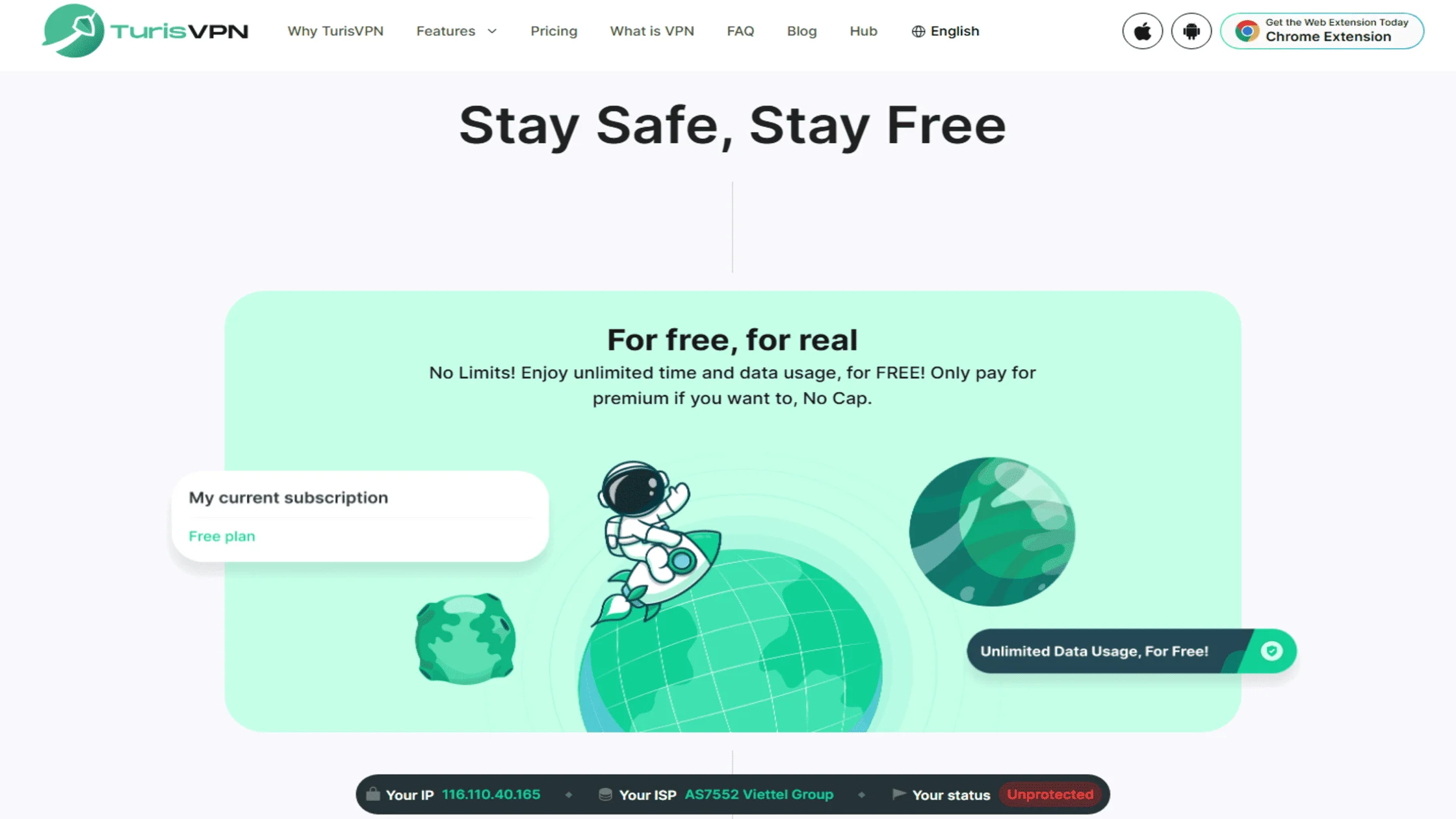
Instead of gambling with a shady free app, we recommend using a service that guarantees your privacy. If you are searching for the best free, unlimited Android VPN, TurisVPN stands out for offering a secure, data-cap-free experience that rivals paid services. We offer robust encryption and high-speed servers that don’t choke your connection.
Here is how to use TurisVPN for unlimited secure browsing:
- Download the TurisVPN app for your mobile phone or install the Chrome Extension on your computer.
- Connect to the “Free” server tab (usually automatically selects the fastest available option).
- Browse without watching a data counter. We use the efficient WireGuard VPN protocol to keep speeds high and battery usage low.
TurisVPN is a great choice, but who exactly is the target audience for free unlimited services?
Who should use free unlimited VPNs—and who shouldn’t?
Free unlimited VPNs are ideal for casual users focused on security, but they often fall short for power users who demand high-speed entertainment. Below, we list exactly who benefits most from these services and who should consider upgrading.
You SHOULD use a free unlimited VPN like TurisVPN if:
- You need protection on public Wi-Fi (cafes, airports).
- You are traveling and need to access your home banking securely.
- You are on a budget but refuse to compromise on privacy.
You SHOULD NOT use a free VPN if:
- You are a heavy 4K streamer (requires premium bandwidth).
- You need to change your location to 20 different countries daily.
- You are torrenting large files 24/7
Bottom Line
Can free VPNs really offer unlimited data? Yes, but the trade-offs in speed, security, and privacy are rarely worth it. While you might not see a data cap, you will feel the restrictions in other ways. “Unlimited” in the free market usually implies unlimited frustration with slow loading times and blocked content.
We believe your digital privacy is worth more than saving a few dollars. Investing in a reliable service like TurisVPN ensures you get the speed you need without worrying about who is watching over your shoulder. Choose wisely and protect your data.
FAQs
Q1. Why do free VPNs throttle speed if data is unlimited?
Providers throttle speed to manage Server Congestion. By slowing you down, they discourage heavy usage (like 4K streaming) that would crash their network, while still technically allowing you to browse “unlimited” pages.
Q2. Can free unlimited VPNs be used for streaming?
Generally, no. Most free VPNs are too slow for HD video. Also, streaming platforms block the IP addresses of free VPNs very quickly.
Q3. Do free VPNs sell user data?
Many do. This is the primary revenue source for free VPNs without a premium tier. Always check the privacy policy. TurisVPN never sells user data.
Q4. Are free VPNs safe for banking/email?
We do not recommend it. Only if they use strong encryption, such as AES-256 or WireGuard. Avoid random, unverified apps on the Play Store. To ensure your connection is secure, learn how to check if your VPN is working.
Q5. Is unlimited VPN data the same as unlimited bandwidth?
No. Unlimited data means you can download as much as you want. Unlimited bandwidth refers to the speed at which you can download it. Free VPNs often give you the first but limit the second.
Q6. Why do free VPNs disconnect frequently?
Free servers are often overcrowded. To make room for new users, the server may drop your connection. It can also be due to unstable protocols; check the VPN protocol you should use for better stability.
Q7. Can free VPNs bypass geo-restrictions?
Sometimes, but it’s hit-or-miss. Free VPNs have fewer servers, making them easier for websites to detect and block.
Q8. Should I use a free VPN or a paid VPN trial?
A paid VPN trial is almost always better. It gives you the full premium experience, fast speeds, and security, so you can test the service properly.
Q9. Do VPNs work on cellular data?
Yes, VPNs work on cellular data networks like 4G and 5G. A good mobile VPN app will encrypt your data whether you are on Wi-Fi or using your mobile carrier’s plan. This protects you from tracking by your cell provider.